Open letter,
Lagos–Calabar Coastal Road Contract
To Engr. Dave Umahi, Honorable Minister, Federal Ministry of Works and Housing
Dear Hon. Minister,
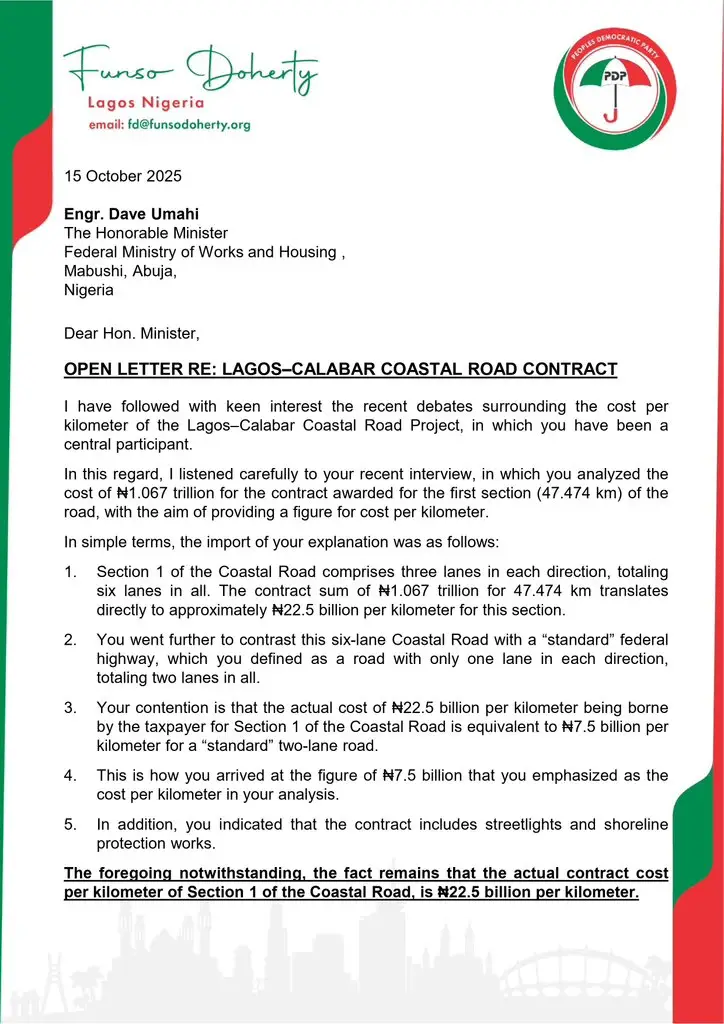
I have followed with keen interest the recent debates surrounding the cost per kilometer of the Lagos–Calabar Coastal Road Project, in which you have been a central participant.
In this regard, I listened carefully to your recent interview, in which you analyzed the cost of ₦1.067 trillion for the contract awarded for the first section (47.474 km) of the road, with the aim of providing a figure for cost per kilometer.
In simple terms, the import of your explanation was as follows:
- Section 1 of the Coastal Road comprises three lanes in each direction, totaling six lanes in all. The contract sum of ₦1.067 trillion for 47.474 km translates directly to approximately ₦22.5 billion per kilometer for this section.
- You went further to contrast this six-lane Coastal Road with a “standard” federal highway, which you defined as a road with only one lane in each direction, totaling two lanes in all.
- Your contention is that the actual cost of ₦22.5 billion per kilometer being borne by the taxpayer for Section 1 of the Coastal Road is equivalent to ₦7.5 billion per kilometer for a “standard” two-lane road.
- This is how you arrived at the figure of ₦7.5 billion that you emphasized as the cost per kilometer in your analysis.
- In addition, you indicated that the contract includes streetlights and shoreline protection works.
The foregoing notwithstanding, the fact remains that the actual contract cost per kilometer of Section 1 of the Coastal Road, is ₦22.5 billion per kilometer.
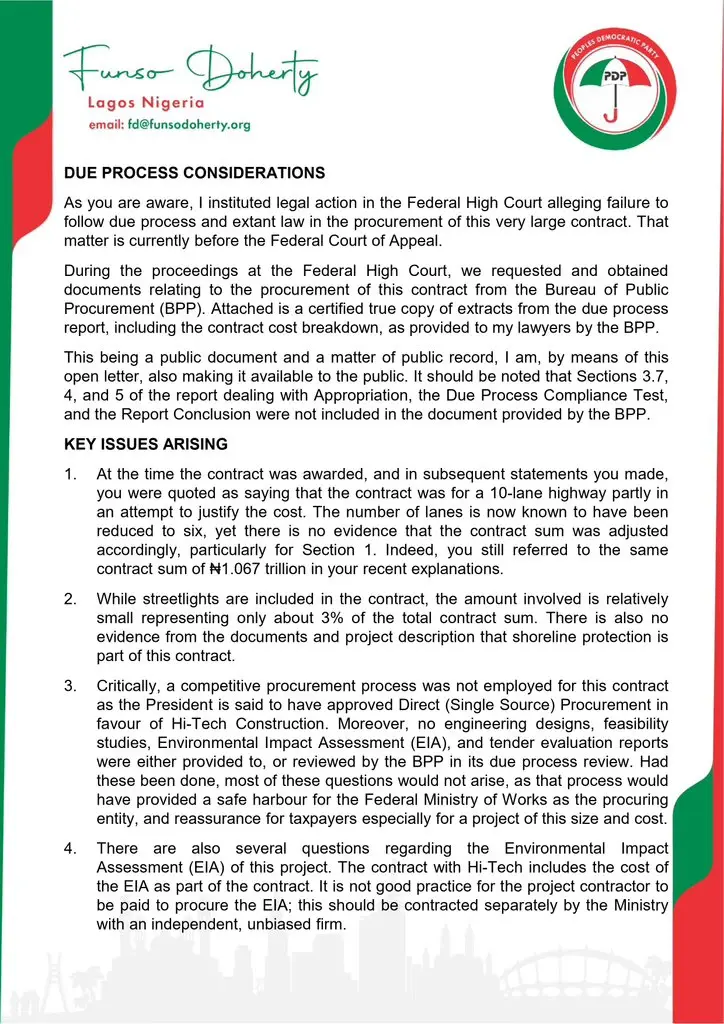
Due Process Considerations
As you are aware, I instituted legal action in the Federal High Court alleging failure to follow due process and extant law in the procurement of this very large contract. That matter is currently before the Federal Court of Appeal.
During the proceedings at the Federal High Court, we requested and obtained documents relating to the procurement of this contract from the Bureau of Public Procurement (BPP). Attached is a certified true copy of extracts from the due process report, including the contract cost breakdown, as provided to my lawyers by the BPP.
This being a public document and a matter of public record, I am, by means of this open letter, also making it available to the public. It should be noted that Sections 3.7, 4, and 5 of the report dealing with Appropriation, the Due Process Compliance Test, and the Report Conclusion were not included in the document provided by the BPP.
Key Issues Arising
- At the time the contract was awarded, and in subsequent statements you made, you were quoted as saying that the contract was for a 10-lane highway partly in an attempt to justify the cost. The number of lanes is now known to have been reduced to six, yet there is no evidence that the contract sum was adjusted accordingly, particularly for Section 1. Indeed, you still referred to the same contract sum of ₦1.067 trillion in your recent explanations.
- While streetlights are included in the contract, the amount involved is relatively small representing only about 3% of the total contract sum. There is also no evidence from the documents and project description that shoreline protection is part of this contract.
- Critically, a competitive procurement process was not employed for this contract as the President is said to have approved Direct (Single Source) Procurement in favour of Hi-Tech Construction. Moreover, no engineering designs, feasibility studies, Environmental Impact Assessment (EIA), and tender evaluation reports were either provided to, or reviewed by the BPP in its due process review. Had these been done, most of these questions would not arise, as that process would have provided a safe harbour for the Federal Ministry of Works as the procuring entity, and reassurance for taxpayers especially for a project of this size and cost.
- There are also several questions regarding the Environmental Impact Assessment (EIA) of this project. The contract with Hi-Tech includes the cost of the EIA as part of the contract. It is not good practice for the project contractor to be paid to procure the EIA; this should be contracted separately by the Ministry with an independent, unbiased firm.
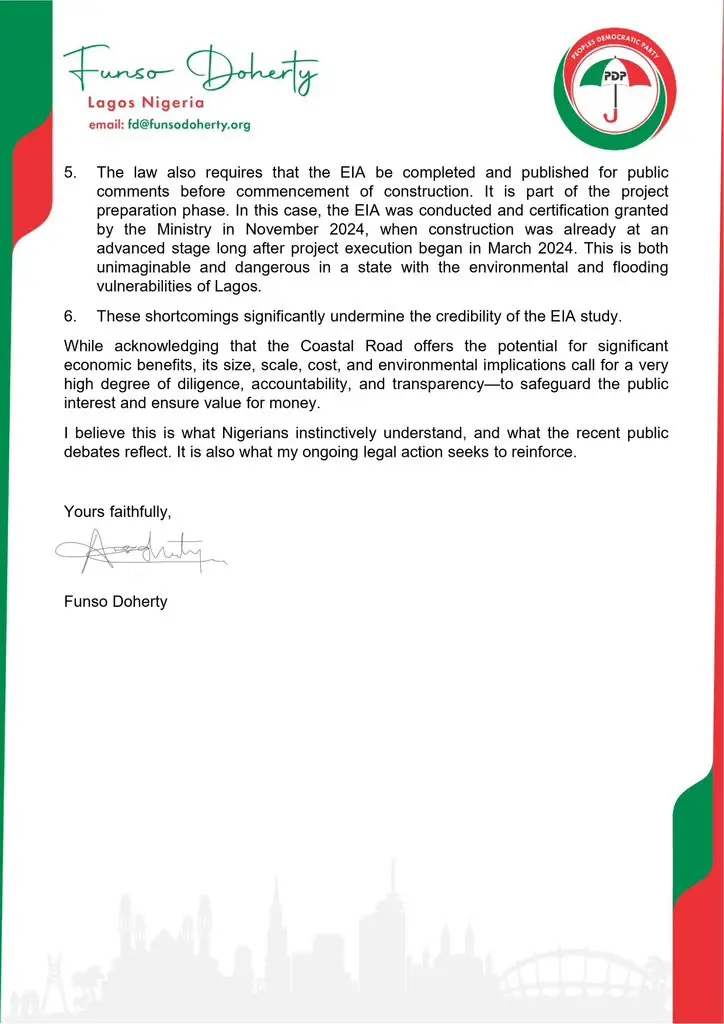
- The law also requires that the EIA be completed and published for public comments before commencement of construction. It is part of the project preparation phase. In this case, the EIA was conducted and certification granted by the Ministry in November 2024, when construction was already at an advanced stage long after project execution began in March 2024. This is both unimaginable and dangerous in a state with the environmental and flooding vulnerabilities of Lagos.
- These shortcomings significantly undermine the credibility of the EIA study.
While acknowledging that the Coastal Road offers the potential for significant economic benefits, its size, scale, cost, and environmental implications call for a very high degree of diligence, accountability, and transparency—to safeguard the public interest and ensure value for money.
I believe this is what Nigerians instinctively understand, and what the recent public debates reflect. It is also what my ongoing legal action seeks to reinforce.
Yours faithfully,
Funso Doherty
The Signed Letter
As scanned for the campaign's compilation of his letters. Tap a page to open it full size.