Open letter,
Lagos State Government's 2025 Approved Budget
To His Excellency, Babajide Sanwoolu, Governor, Lagos State
Dear Mr. Governor,
Earlier this week, the Lagos State House of Assembly passed the 2025 Appropriation Bill, to which you have subsequently given assent.
I note that the executive had presented a budget of approximately N3.0 trillion to the House, which the House, opted to further increase to N3.37 trillion before passing. The approved budget represents a 49% increase over the 2024 budget of approximately N2.26 trillion and incorporates deficit financing of approximately N400bn.
This letter outlines some areas of concern arising from the State’s approved budget.
1. The Overall Budget Size is Unrealistic:
At 3.37 trillion, the overall 2025 budget is, in my opinion, unrealistic. This is not particularly surprising as there appears to be an established pattern of LASG’s actual receipts and expenditures falling substantially short of the approved estimates in each of the last five years up to 2023, for which audited data is available. As at September, 2024, with only three months left to the end of the year, interim figures show that the State’s actual receipts and expenditures were a far cry from the approved 2024 budget of N2.26 trillion, despite the elevated FAAC allocations during the year.
2. Lagos State’s Debt Has Risen Sharply and is mostly owed in foreign currency
Of greater concern is the fact that in the eighteen-month period between January 2023 and June 2024, Lagos State’s reported total outstanding debts rose sharply (almost double) from approximately N1.4 trillion to approximately N2.69 trillion, an increase of N1.3 trillion in Naira terms. A key reason for this is the effect of LASG’s decision over the years to borrow substantially in foreign currency and the depreciation that occurred in the Naira over the period.
Foreign currency loans make up the majority of Lagos State’s debts. As I have said in the past, and as this experience painfully shows, it is not good practice for a Sub-National Government with a predominantly local-currency revenue base to undertake and maintain such significant borrowing in foreign currency as it exposes the State and its citizens to great currency risk. This is especially ill-advised in an economy like Nigeria’s with its history of recurrent volatility in the value of the Naira.
3. Recent Developments heighten Uncertainty around The State’s Financial Position
The recent judgment by the Supreme Court on the financial autonomy of Local Governments has significant implications for all State Governments including Lagos. As a result of the practical balance of power and control over disbursements that they wielded before the ruling, State Governments may have, in the past, tacitly considered the cash flow from LG allocations in their assessment of their overall financial and/or debt capacity and in their borrowing decisions. Any such assumptions may no longer be appropriate. Furthermore, even where LGs benefitted from the use of pre-existing debts contracted by the State Government, such debts remain the responsibility of the State Government. Going forward, it is the State Government’s revenues, including its IGR and its share of FAAC revenues only (and not that of the LGs), that can be relied upon to support both spending and debt service. Any alternative or transitional arrangements in this regard will have to be negotiated with the local governments who, by virtue of the Supreme Court ruling, are not obliged to accommodate the State. It is also possible that as the trend towards autonomy that has now started gathers momentum, it may subsequently begin to impact not just statutory allocations, but also certain IGR sources hitherto collected and administered by State Governments, as LGs increasingly assert their claims on any IGR sources considered to be within their constitutional purview.
Separately, the recently proposed Tax Reform Bill that is presently being debated in the National Assembly may bring significant change to the revenues of the States including Lagos. Different States will be affected differently and while there is much on-going discussion around this, what is clear is that there will be intended and unintended short-term effects that could be positive or negative for each State based on their unique circumstance and based on the specific provisions that are eventually passed into law. As for longer-term consequences, these will only become evident with time.
4. There should be greater transparency around the budget process
The detailed breakdown of the 2025 budget is not in the public domain. You may recall that I had in the past questioned the inclusion in the 2023 budget breakdown, (when it was available long after passage of the budget) of a line item under the general expense category for “Special Duties Expenses” in the colossal amount of N212bn. Alarmingly, this recurred in 2024 and was further increased to N249 bn. We await the breakdown of the 2025 budget to see if such undesirable trends persist. Citizens and other stakeholders deserve and would benefit from a detailed breakdown of the proposed budget while it is being debated in the legislature prior to signing it into law.
Imperatives
In view of the foregoing, I would advise as follows:
- A cohesive, deliberate strategy and practical plans must be developed and implemented to address the State’s relatively large exposure to foreign borrowings and currency risk
- It should also be recognized that we may be witnessing a sea-change in the structure and delivery of sub-national governance between State and local governments as a result of the very consequential ruling by the Supreme Court, the full extent and impact of which are just now unfolding
- In this regard, a budget such as the one approved, that envisages very aggressive spending at the State Government level, enabled by additional borrowing is not prudent and would be ill-advised at this time of heightened uncertainty and potential change
- Consequently, any proposal to take on significant Additional debt at the State Government level should be approached with caution and preferably avoided for the time being. Non-debt financing of different forms should be explored through processes that are transparent, and these must always be subjected to due diligence and process.
- The focus at this time should be on efficiency, transparency, reducing cost of governance, leakages, corruption and waste. We can do substantially more with less.
- Finally, the prioritization of expenditure should be more people-oriented, as the key to our long-term development and prosperity lies in the people. Despite the long list of activities of Government enumerated in your 2025 and preceding budget speeches over the years, some shortcomings in certain basics that are central to human development continue to be glaringly evident. For example, in the first 9 months of 2024, spending on education and health were only about 7% and 6.5% of total expenditure respectively. In 2023, actual expenditure on these were of the order of 7-8%. These levels are grossly inadequate to deliver the human capital foundation upon which a broad-based prosperous society can be built. In particular, substantially more is needed in the area of primary education which, despite the alarming incidence of out-of-school children, and the well-known paramount importance of early childhood education, appears to be accorded a low priority by the State in the allocation of expenditure. Technical education also needs substantially more focus and investment. We can point to similar shortcomings in terms of effectiveness and actual outcomes achieved in other basic, yet development-critical areas. Examples include provision and availability of potable public water across the state, as well as truly effective mass transit options on a large scale that can serve a large proportion of the city’s teeming commuters and be a catalyst for decentralized development of mass affordable housing, industry, organized commerce and recreational activity in different areas across the state, to name a few.
Thank you for your attention,
Funso Doherty
CC:
- RT Hon. Mudashiru Obasa, Speaker, Lagos State House of Assembly.
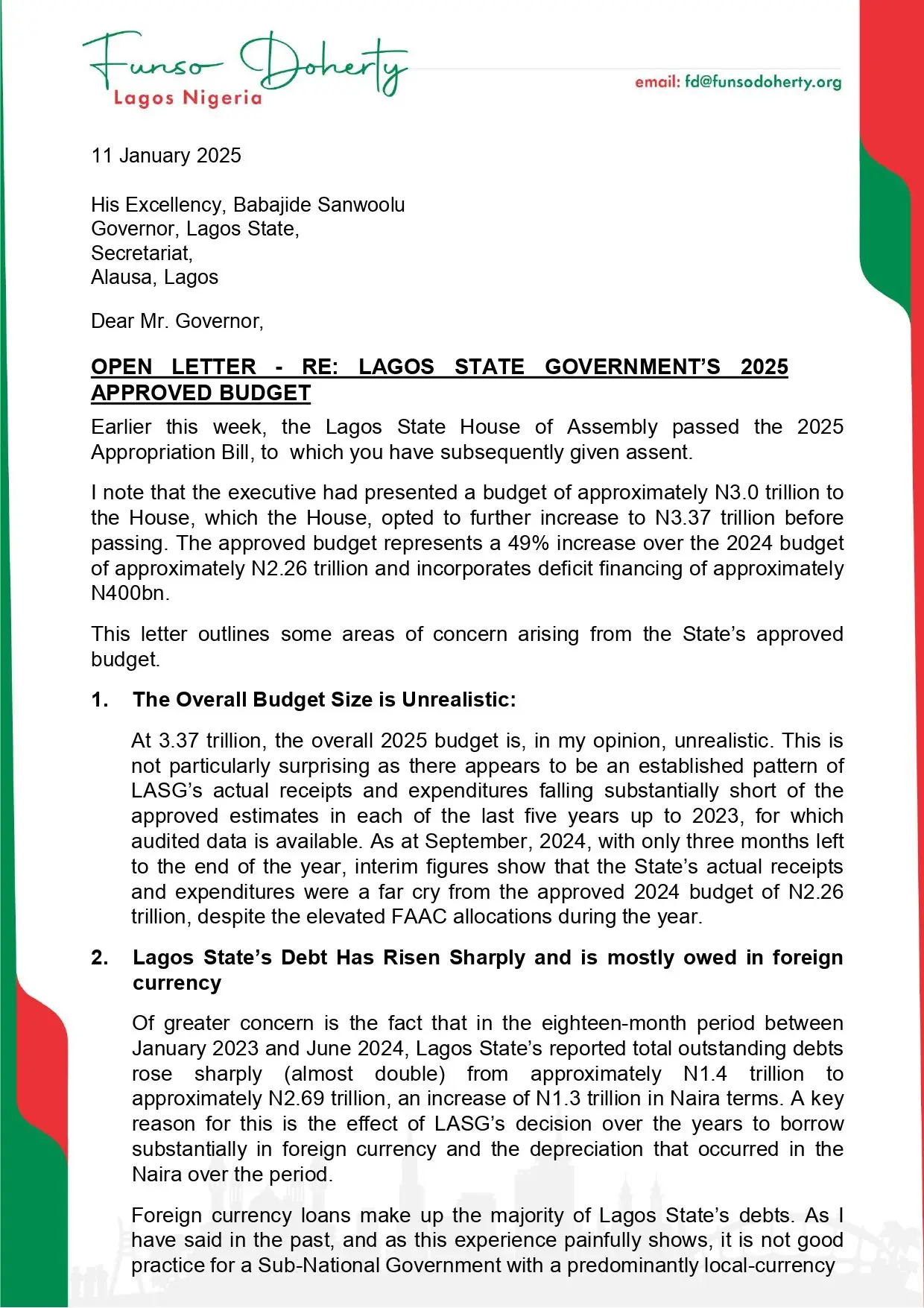
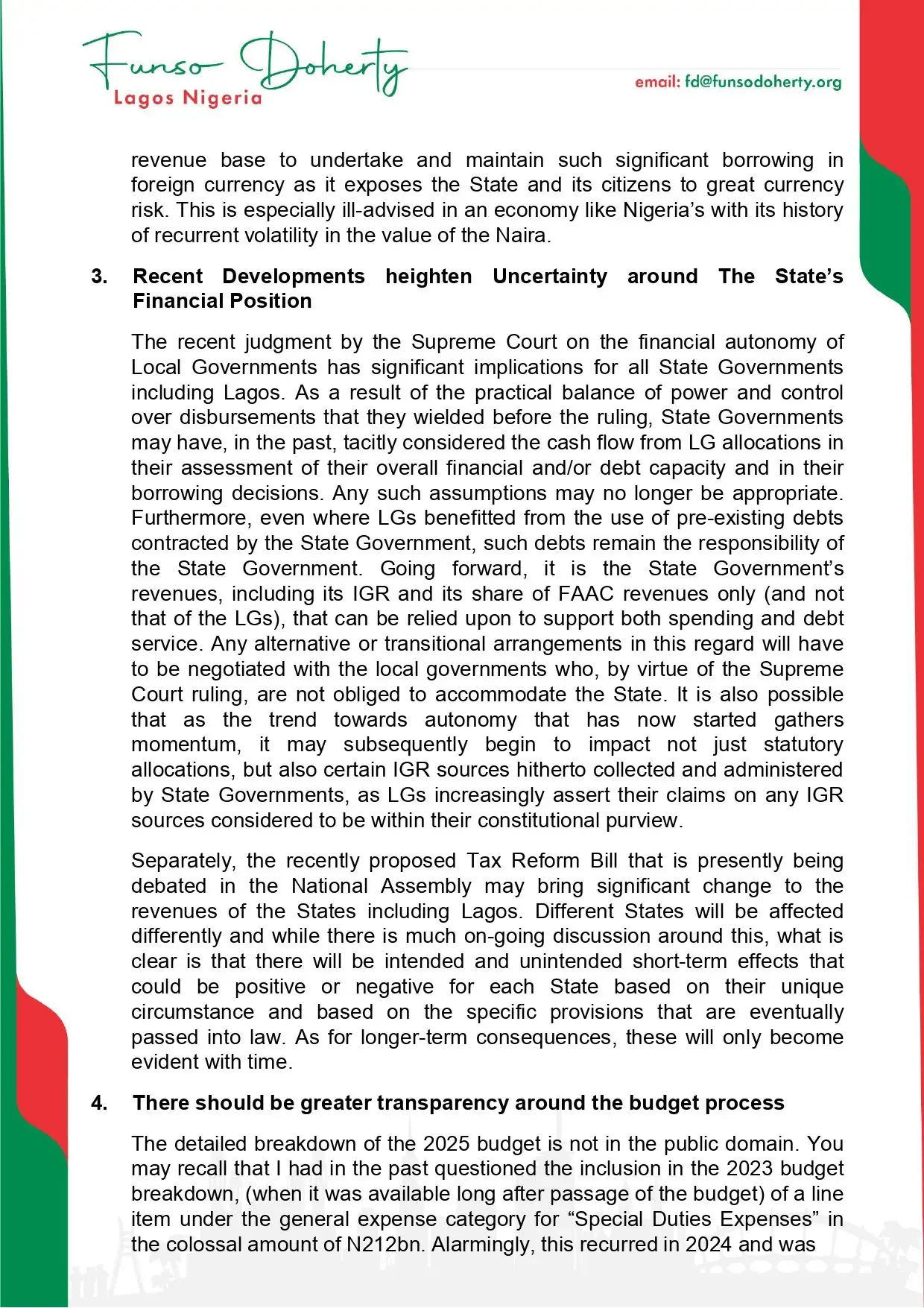
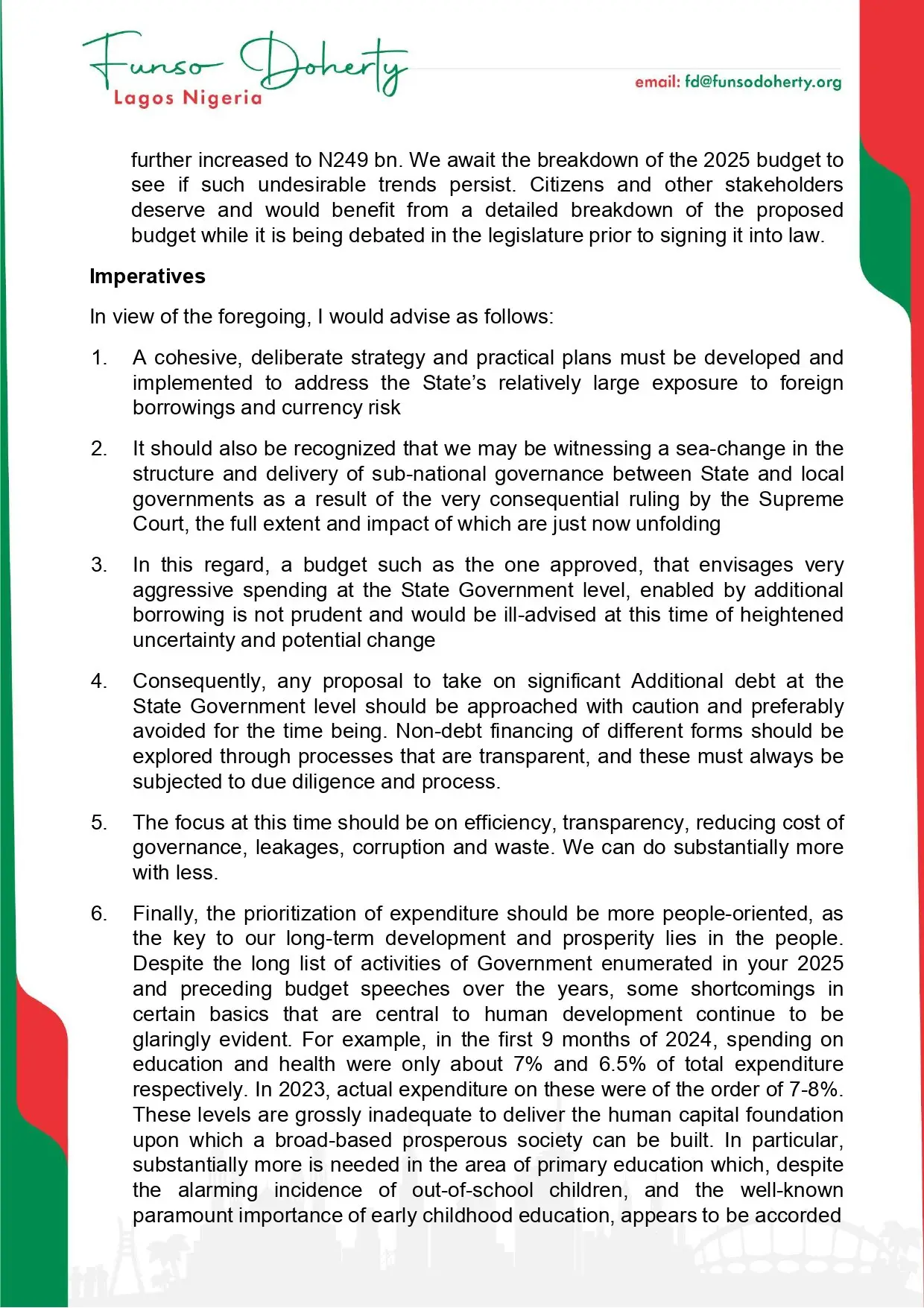
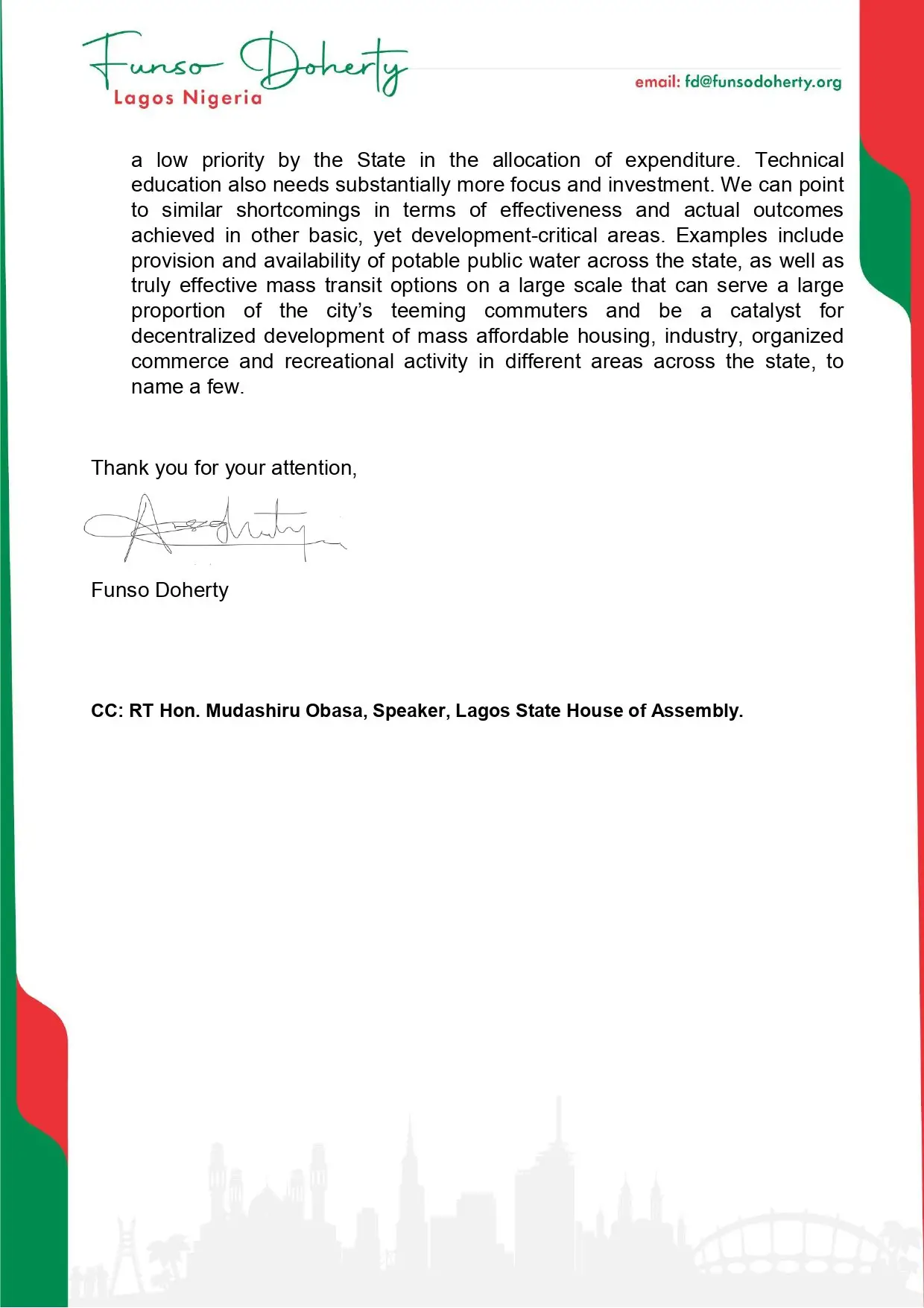
The Signed Letter
As scanned for the campaign's compilation of his letters. Tap a page to open it full size.