Open letter,
Memorandum of Understanding Between FGN and MPH Rail Development (UK) Limited on the Port-Harcourt-Calabar-Enugu-Abuja Standard Gauge Rail Project
To Distinguished Senator Godswill Akpabio, President of the Senate; and Rt. Honorable Tajudeen Abbas, Speaker of the House of Representatives
Dear Mr. President and Mr. Speaker,
Background
Last week, on the 13th of March, the Federal Ministry of Transport announced that it had signed an MOU with a UK registered private company, MPH Rail Development Limited, “to enable the company carry out the design, construction, commissioning, operation and transfer of the Port-Harcourt-Calabar-Enugu-Abuja rail line on a public private partnership basis.” According to the statement, the MOU “was executed following the approval of Outline Business Case and issuance of a compliance certificate by the Infrastructure Concession and Regulatory Commission (ICRC)”. It heralded the signing of this MOU as “a landmark achievement for the Tinubu administration”.
In a striking reversal just four days later, following widespread criticism mainly relating to MPH Rail’s suitability as a counter party in such a significant project, the FGN in a second statement described the same MOU as a non-binding, preliminary document merely intended “to provide a platform for further discussions between parties to ascertain the possibility of executing the project or otherwise.”
Questions Arising
These announcements and the related sequence of events call for further and immediate scrutiny, despite the Ministry’s attempt to downplay their significance. In particular:
1. Status of the Project
Given the facts, the Ministry’s latest, reactionary portrayal of the status of this project as only “the beginning of a long process” is, in my opinion, duplicitous and misleading. Submission of an Outline Business Case (OBC), approval by the ICRC and issuance of OBC Compliance Certificate all of which, according to the Ministry, have been done in this case, are definitive and significant milestones in both the National Policy on PPP’s as well as the ICRC’s PPP guidelines (see attached).
The guidelines require that preliminary due diligence work should have already been done on both the project and the private sector proponent (MPH Rail) to justify OBC certification including, among others, assessments of:
- Capacity to finance, deliver, construct and operate the project.
- A technical feasibility study
- Estimated total project cost and financial model
- Environmental and other Social Impacts
OBC certification by ICRC signals the successful completion of the Project Development and Preparation Phase and enables commencement of the Procurement Phase of PPPs.
2. The Project Proponent – MPH Rail
There is nothing in the short corporate history of MPH Rail Development to suggest that it has the capacity to undertake such a project. Its shareholding is nominal at GBP1,000 (One thousand Pounds Sterling). It is not clear what is the basis of the Ministry’s assertion, contained in its second press statement, that MPH Rail is an SPV incorporated by an entity called the British African Business Alliance (BABA), as BABA is not a shareholder of MPH. In any case, association with BABA does not confer credibility on MPH for this purpose as BABA is itself a micro-entity in the UK, that primarily aims to facilitate networking and information sharing by business entities rather than functioning itself as a principal.
Notably, MPH’s proposal was originally submitted to the Ministry as far back as August 2019. It is concerning to observe that the immediate past Speaker of the Lagos State House of Assembly, Adeyemi Ikuforiji was appointed a director of MPH and allotted a 20% interest in the Company in August, 2023. Shortly thereafter, in December 2023, MPH’s Outline Business Case was forwarded by the Ministry to the ICRC and approved that same month.
Subsequent to the announcement of the MOU and widespread awareness and criticism of his involvement with the Company the former Speaker has resigned from the Board of the Company and transferred his shares to another director effective March 15, 2024.
3. Process Undertaken
Apart from the suitability of the Sponsor, there are a number of critical deficiencies in the processes so far adopted or indicated for pursuing this initiative:
- a) It is not clear why this is being characterized and pursued as an unsolicited PPP project. Rail infrastructure development using PPPs is neither a newly identified nor a trivial undertaking by the FGN and is presumably being undertaken in segments/phases based on integrated plans. Indeed, the FGN has repeatedly talked about its rail infrastructure master plans for over a decade. Consistent with the ICRC Act, National PPP Policy and Guidelines, these projects should generally be publicly advertised and pursued via pre-qualification and competitive processes.
- b) Even for unsolicited PPPs, once an OBC is approved, the next phase should be an advertised, competitive procurement process. This is a requirement of the law as well as the guidelines. The process implied by the Ministry where MPH is to now proceed, based on OBC certification to produce documents including a Full Business Case for approval to execute the project is wrong. The guidelines require that the bidder that emerges successfully in the competitive procurement bidding phase that follows OBC certification, (which may or may not be MPH), will proceed to put forward a Full Business Case for approval and execution.
- c) By the Ministry’s own statements, the basic requirements to demonstrate a bankable Outline Business Case such as satisfactory assessments of proponent’s capacity to deliver, technical feasibility, estimates of financial costs and models as well as environmental impact assessments are not yet in place, and these are what MPH is now expected to produce. In view of these fundamental deficiencies, the OBC should not have made it to ICRC for approval in the first place and, more importantly, there is no basis for ICRC issuing a compliance certificate.
Conclusion and Imperatives
All over the world, Public-Private-Partnerships are accepted as useful potential means of bridging public sector infrastructure funding and capacity gaps. At the same time, evidence also abounds the world over that if not implemented and governed diligently, the short and long-term potential of PPPs for destructive and extractive transfer of societal resources from the general public to a privileged few is almost unparalleled.
This project demonstrates a number of red flags, some of which are highlighted above. While the Ministry bears primary responsibility in this and similar projects, the role of the ICRC, as the entity empowered by law as regulator and custodian of the public interest in these matters, is very critical, and in this case, is of particular concern.
As a first step, this PPP project should be halted from proceeding further. I hereby call on the National Assembly, in exercise of its oversight powers, to speedily undertake a review and investigation of this and other such PPP projects to provide assurance of diligent and effective application of the Approval, Regulatory, Governance and Disclosure processes that are intended to secure value for money and protect the public interest in PPPs implemented pursuant to the ICRC Act.
Thank You.
Funso Doherty.
Cc:
- Senate Committee on Public Procurement
- House Committee on Public Procurement
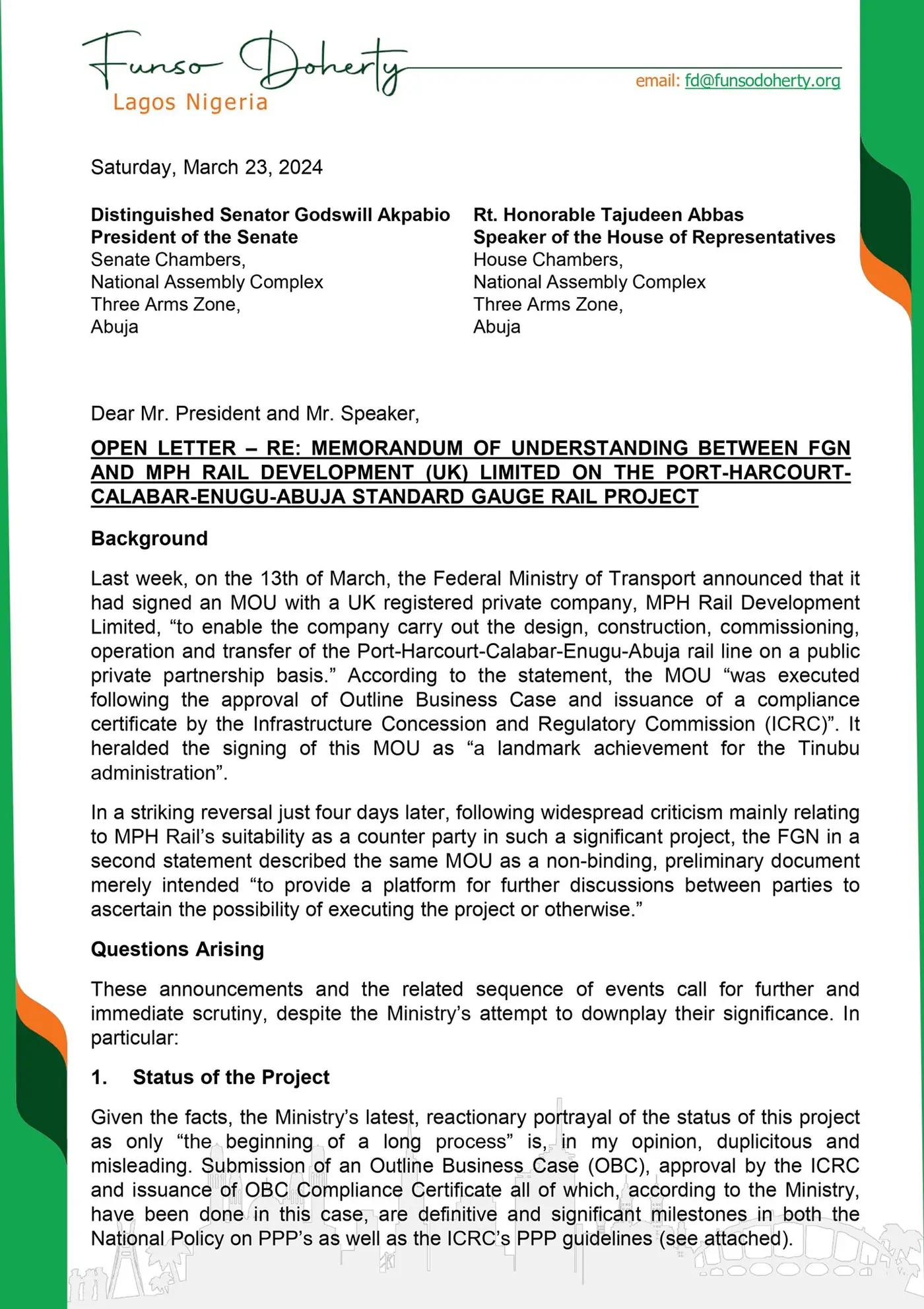
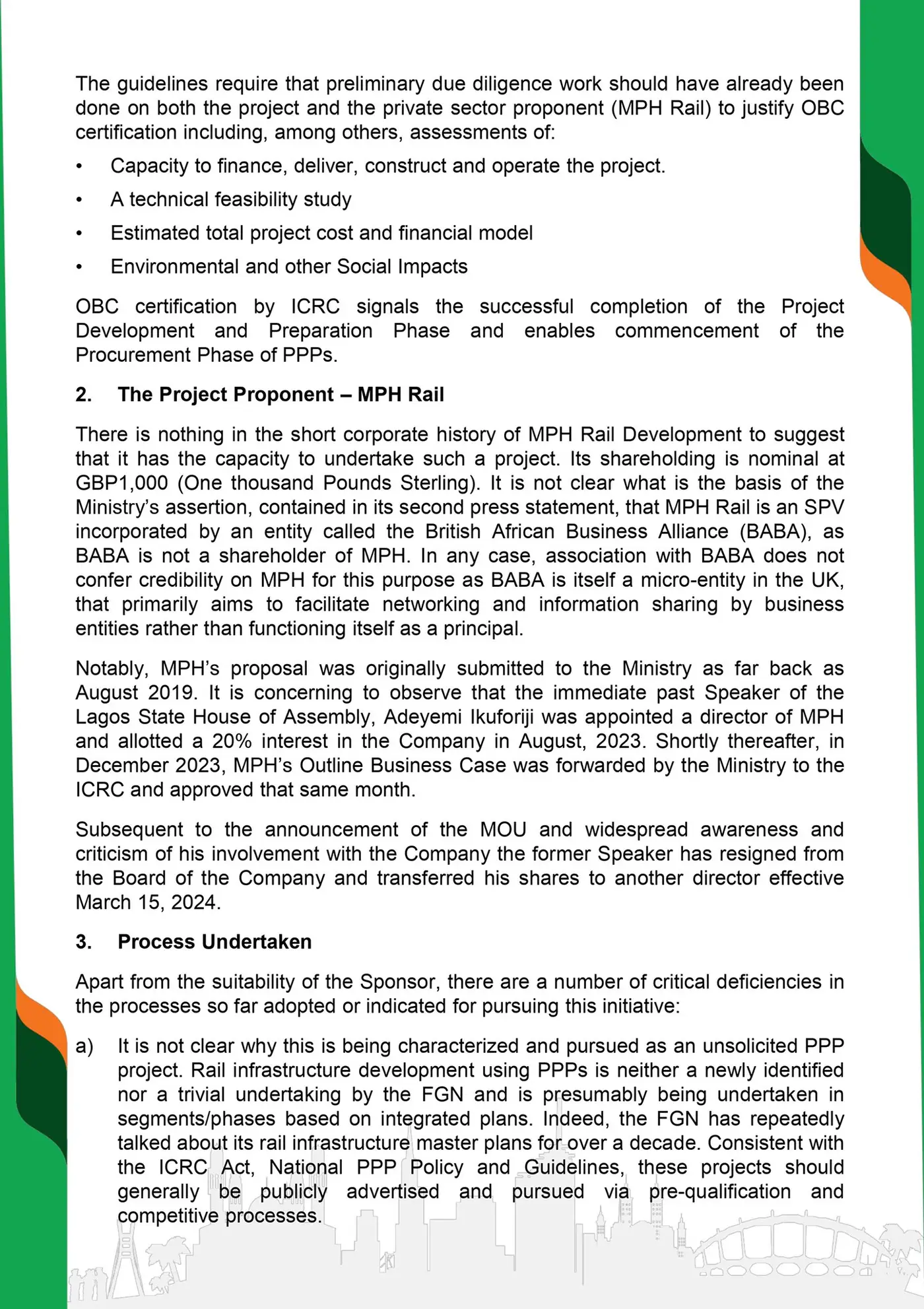
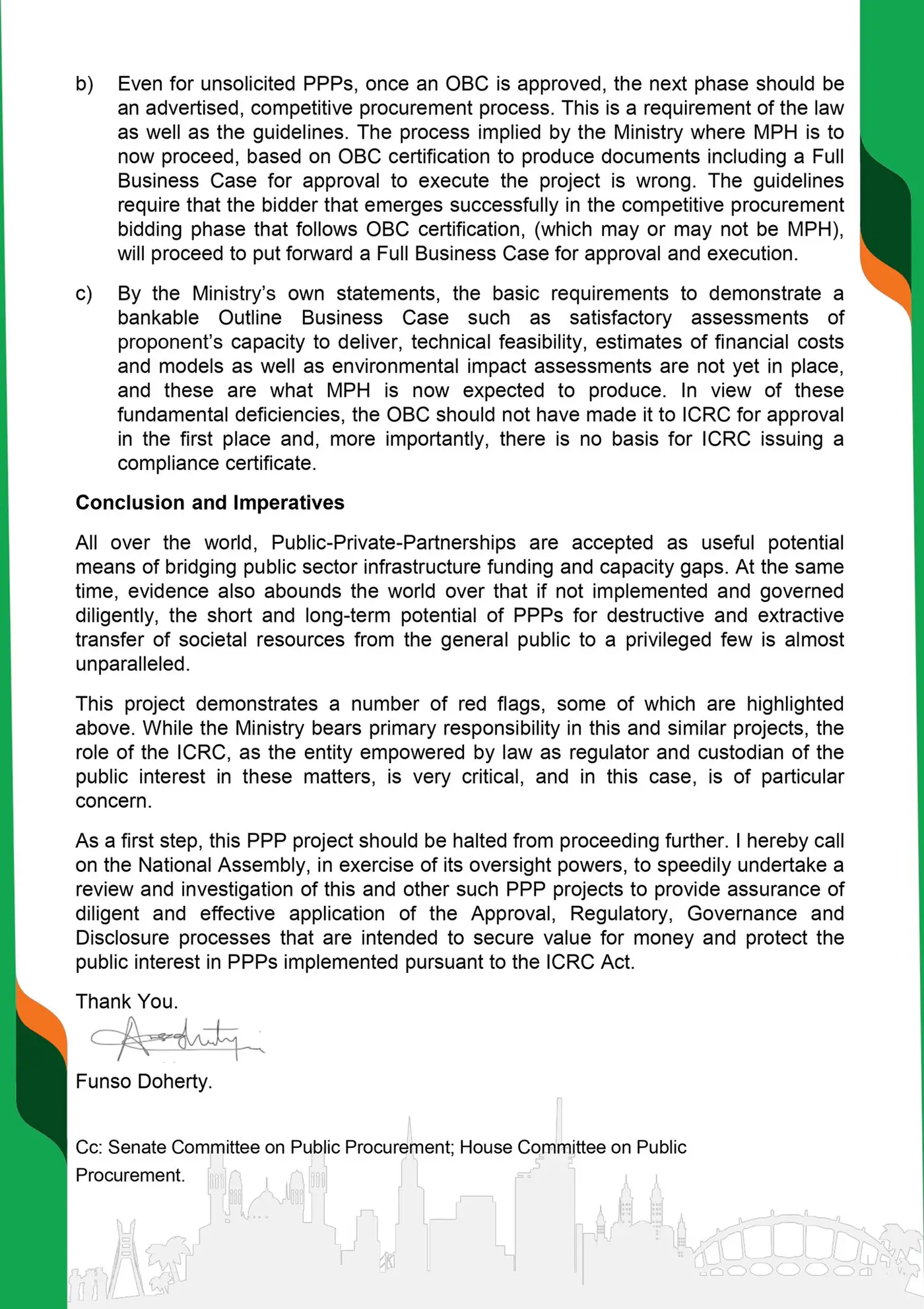
The Signed Letter
As scanned for the campaign's compilation of his letters. Tap a page to open it full size.