Open letter,
Request for Investigation into Recent Developments in the Nigerian Foreign Exchange Market (NAFEM)
To Sen. Adetokunbo Abiru, Chairman, Senate Committee on Banking, Insurance and Other Financial Institutions; Dr. Adamu Abdullahi, Acting Executive Vice Chairman/Chief Executive Officer, Federal Competition & Consumer Protection Commission; Mr. Lamido Yuguda, Director General, Security and Exchange Commission; and Mr Olayemi Cardoso, Governor, Central Bank of Nigeria
Dear Sirs,
I write regarding recent developments in the operation of the Nigerian Foreign Exchange Markets that call for urgent regulatory scrutiny.
Background
The official Nigerian Foreign Exchange Market is mainly operated by Banks acting as Authorized Dealers. In this capacity, they interact with the market and with customers. The CBN regulates these Banks and issues rules and guidelines to regulate their foreign exchange activity.
The FMDQ Group (FMDQ) is an institution licensed by the Securities and Exchange Commission (SEC), that provides market infrastructure and trading platforms used in in a number of markets, including the FX Market. Importantly, Nigerian Autonomous Foreign Exchange Market (NAFEM) rates are fixed and published by FMDQ. Data provided by Authorized Dealers, i.e. banks are inputs used by FMDQ to determine the rates. With the unification of the FX markets by the CBN, the NAFEM rate is presently the recognized FX rate of reference.
It is important to note that the FMDQ is itself a related corporate entity that is largely owned by the Authorized Dealing Banks who, collectively, are its majority shareholders. The CBN is a minority shareholder in FMDQ.
Recent Developments
By a circular dated Jan 31, 2024, the Central Bank of Nigeria (CBN) confirmed that Banks had accumulated substantial holdings of foreign currencies for their own account and directed that such holdings be unwound by February 1, 2024. Analyst estimates have put these aggregate holdings, which in effect represent speculation beyond regulatory limits, by licensed banks against the Nigerian naira, in billions of US dollars.
Curiously, two days preceding this directive by the CBN, the FMDQ had abruptly instituted a change, effective Jan 29, 2024, in its methodology for computing the NAFEM rate. With this change in methodology there was a sharp upward movement in the NAFEM rate from 890 N/$ on Jan 26 to 1,413 N/$ on Feb 1, a span of just 3 working days.
Questions Arising and Concerns
- Given their central, advantaged position in the FX Markets, how and why were banks permitted to accumulate and hold such substantial excess speculative FX positions against the Naira in the first place?
- Why did FMDQ’s revision of the rate calculation methodology and the sharp increase in the NAFEM rate coincide with the directive to the banks to unwind their holdings?
- What was the basis of the revision, what is the explanation for the timing chosen and why did it have such a sharp and immediate effect?
- Ordinarily, economics would predict that in a typically functional market, the prospect of banks being forced to become substantial net sellers of large accumulated FX positions should produce downward, not upward, pressure on rates.
- In view of the massive windfall profits that banks make from the resulting revaluation and/or sale of their speculative positions, was there any abuse of their unique and privileged position in the FX markets including their possible influence with the FMDQ?
- Did key participants act appropriately and if not, has harm been suffered by other participants or interested parties?
- Is there moral hazard in permitting banks to derive and retain disproportionate benefits from such speculative activity possibly at the expense of other groups in the economy?
Potential Harm
Beyond the widespread, punishing effect of Naira depreciation on an already traumatized general population, and without prejudice to the outcome of your investigations, permit me to highlight just two out of the very many vulnerable groups that disproportionately bear the burden of negative FX market developments.
- State Governments and their Resident Taxpayers
Many State Governments owe substantial liabilities in foreign currency. My own state, Lagos State has foreign borrowings of approximately $1.26 billion. This amount is higher than its local currency debt obligations and is by far the highest of all the states in the Federation. The movement in the NAFEM rate in just the space of three days last week alone increased Lagos State’s debt burden by over N650 billion. This burden will ultimately be borne by current and future taxpayers in our state.
- Salary Earners, Pension Fund Contributors and Retirees
With devaluation of the Naira, the purchasing power of Salary earners and pension fund holders is substantially diminished. For retirees in particular, this deterioration is often permanent and irreversible. The sharp deterioration witnessed in the exchange rate in the past few weeks is potentially devastating for Retirement Savings Account holders numbering in the millions who, collectively, hold over N16 trillion in accumulated Naira-denominated retirement assets.
Call for Investigation
In view of the foregoing and, within the ambit of your respective mandates, I hereby call on The National Assembly, FCCPC, SEC and CBN to immediately commence investigations to establish the propriety or otherwise of the recent developments in NAFEM with a view to instituting corrective and punitive measures where appropriate.
Thank you
Yours faithfully,
Funso Doherty
Cc:
- Hon Attorney General and Commissioner of Justice, Lagos State.
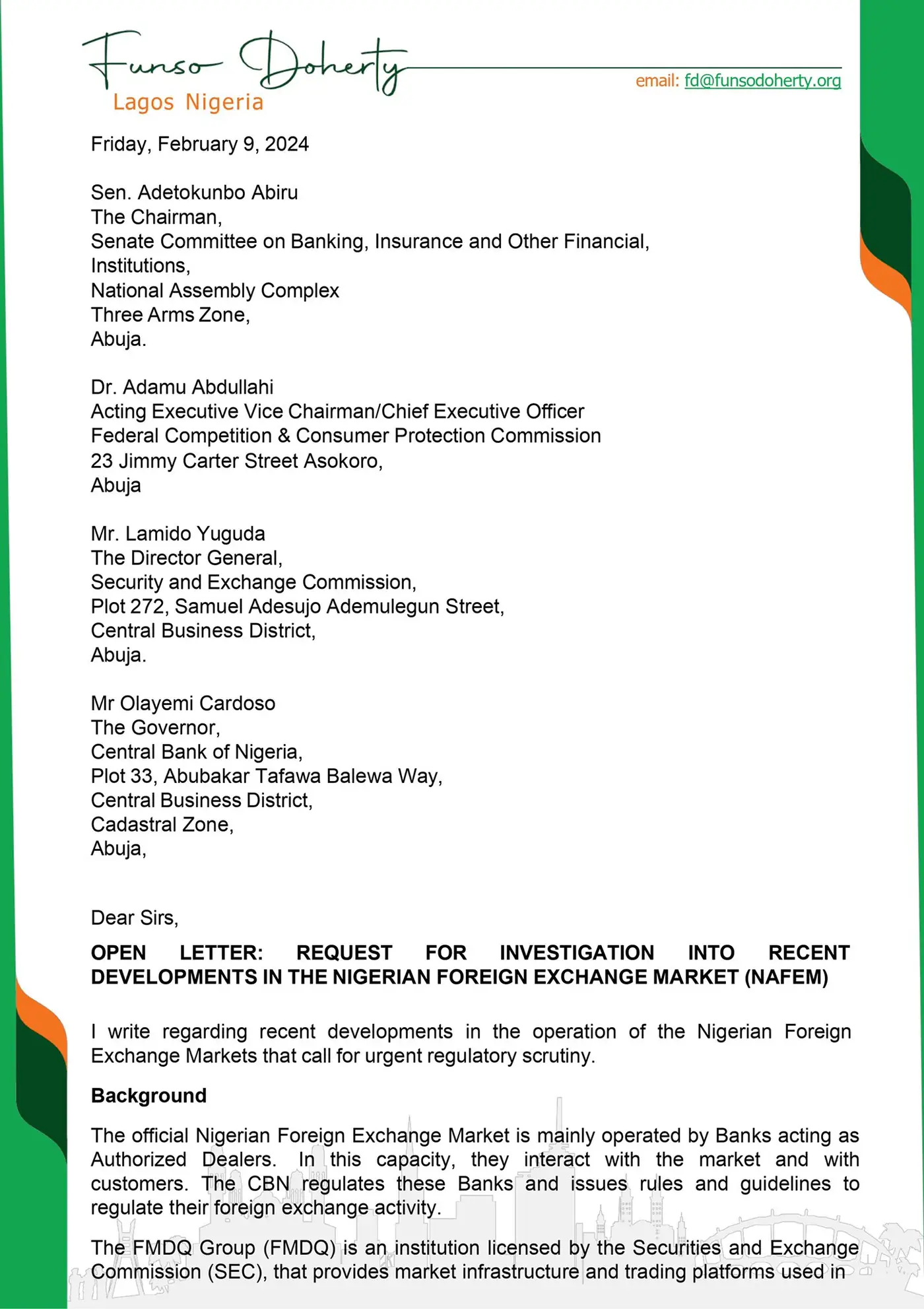
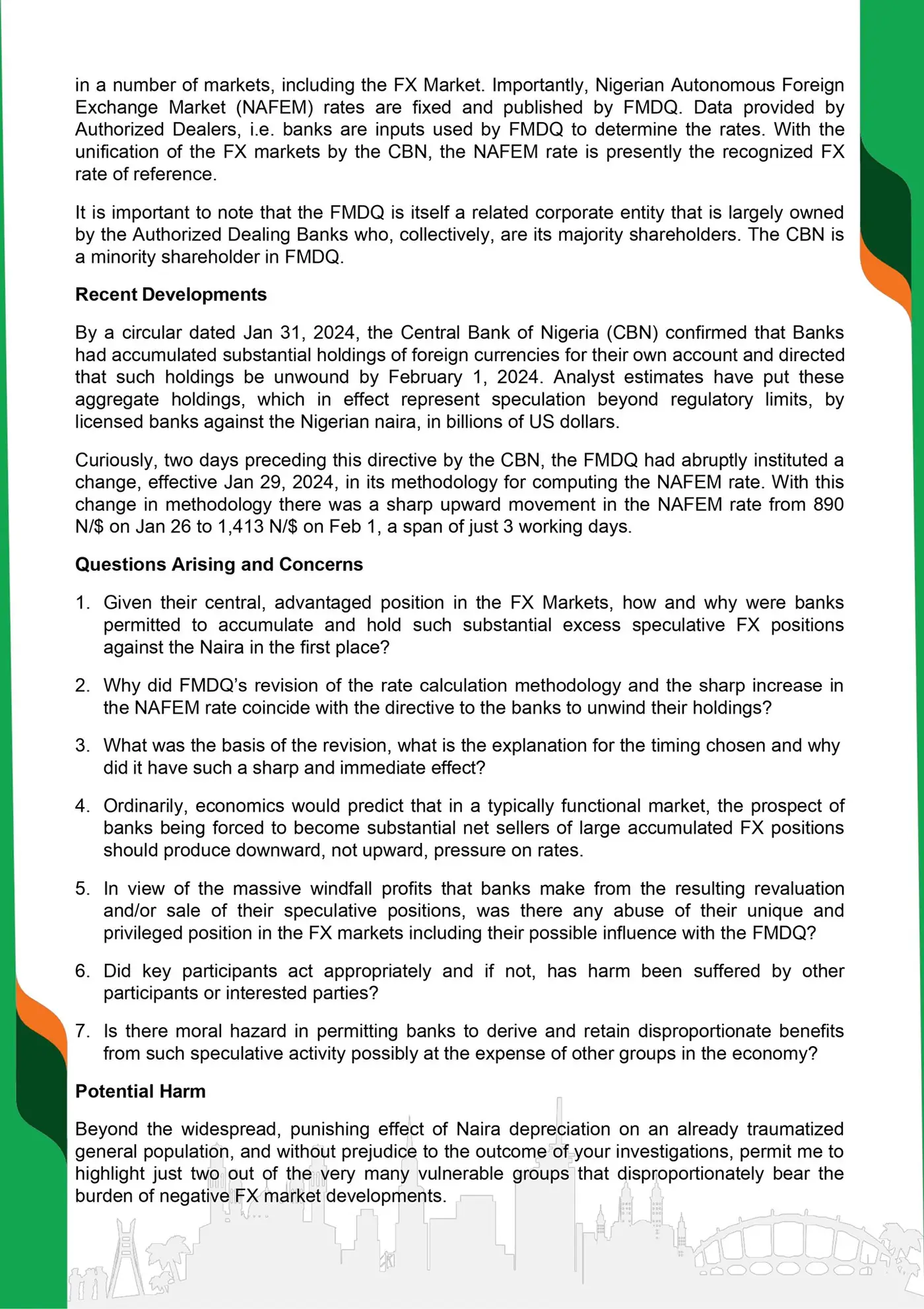
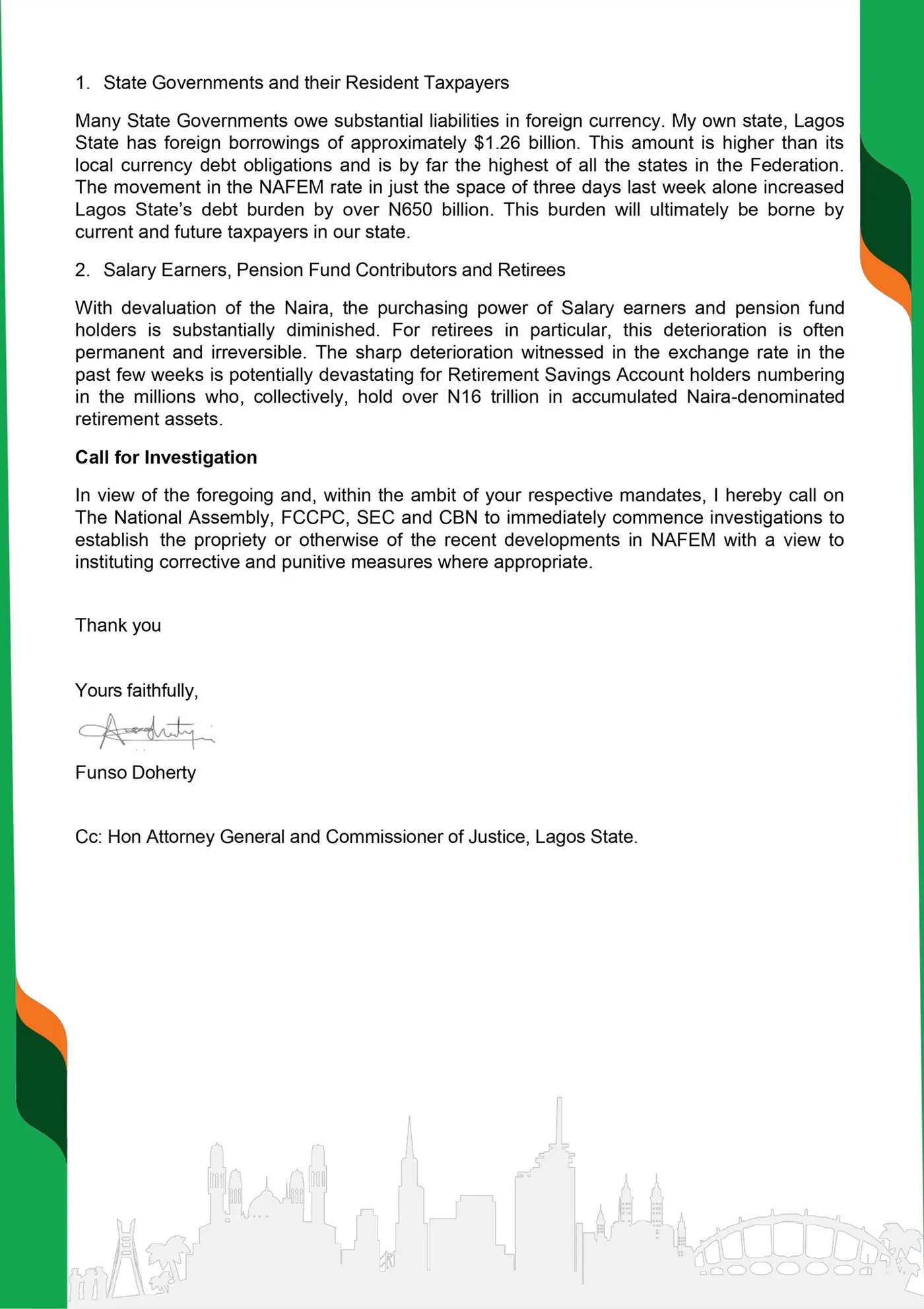
The Signed Letter
As scanned for the campaign's compilation of his letters. Tap a page to open it full size.