Statement,
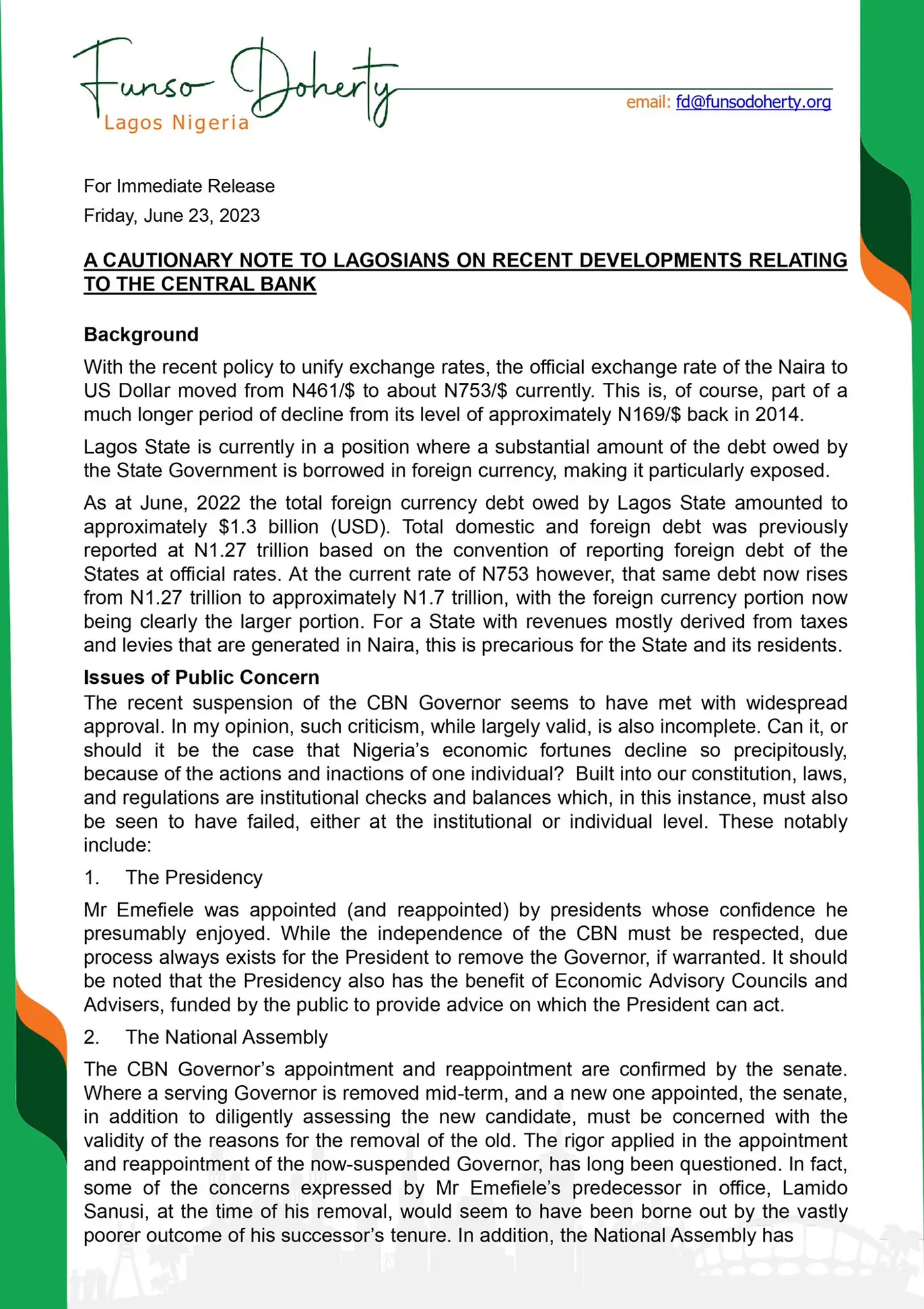
A Cautionary Note to Lagosians on Recent Developments Relating to the Central Bank
Background
With the recent policy to unify exchange rates, the official exchange rate of the Naira to US Dollar moved from N461/$ to about N753/$ currently. This is, of course, part of a much longer period of decline from its level of approximately N169/$ back in 2014.
Lagos State is currently in a position where a substantial amount of the debt owed by the State Government is borrowed in foreign currency, making it particularly exposed.
As at June, 2022 the total foreign currency debt owed by Lagos State amounted to approximately $1.3 billion (USD). Total domestic and foreign debt was previously reported at N1.27 trillion based on the convention of reporting foreign debt of the States at official rates. At the current rate of N753 however, that same debt now rises from N1.27 trillion to approximately N1.7 trillion, with the foreign currency portion now being clearly the larger portion. For a State with revenues mostly derived from taxes and levies that are generated in Naira, this is precarious for the State and its residents.
Issues of Public Concern
The recent suspension of the CBN Governor seems to have met with widespread approval. In my opinion, such criticism, while largely valid, is also incomplete. Can it, or should it be the case that Nigeria’s economic fortunes decline so precipitously, because of the actions and inactions of one individual? Built into our constitution, laws, and regulations are institutional checks and balances which, in this instance, must also be seen to have failed, either at the institutional or individual level. These notably include:
-
The Presidency
Mr Emefiele was appointed (and reappointed) by presidents whose confidence he presumably enjoyed. While the independence of the CBN must be respected, due process always exists for the President to remove the Governor, if warranted. It should be noted that the Presidency also has the benefit of Economic Advisory Councils and Advisers, funded by the public to provide advice on which the President can act.
-
The National Assembly
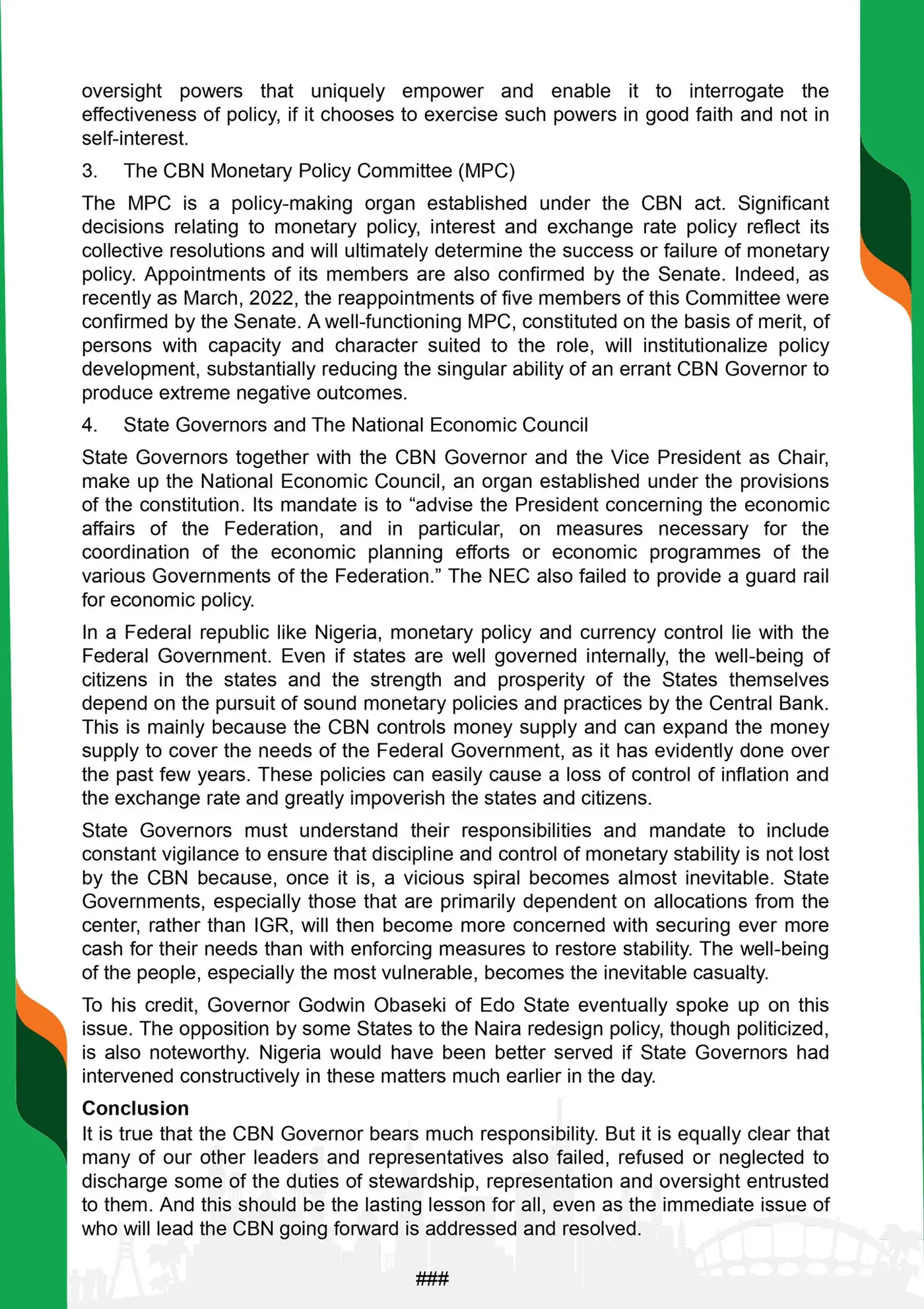
The CBN Governor’s appointment and reappointment are confirmed by the senate. Where a serving Governor is removed mid-term, and a new one appointed, the senate, in addition to diligently assessing the new candidate, must be concerned with the validity of the reasons for the removal of the old. The rigor applied in the appointment and reappointment of the now-suspended Governor, has long been questioned. In fact, some of the concerns expressed by Mr Emefiele’s predecessor in office, Lamido Sanusi, at the time of his removal, would seem to have been borne out by the vastly poorer outcome of his successor’s tenure. In addition, the National Assembly has oversight powers that uniquely empower and enable it to interrogate the effectiveness of policy, if it chooses to exercise such powers in good faith and not in self-interest.
-
The CBN Monetary Policy Committee (MPC)
The MPC is a policy-making organ established under the CBN act. Significant decisions relating to monetary policy, interest and exchange rate policy reflect its collective resolutions and will ultimately determine the success or failure of monetary policy. Appointments of its members are also confirmed by the Senate. Indeed, as recently as March, 2022, the reappointments of five members of this Committee were confirmed by the Senate. A well-functioning MPC, constituted on the basis of merit, of persons with capacity and character suited to the role, will institutionalize policy development, substantially reducing the singular ability of an errant CBN Governor to produce extreme negative outcomes.
-
State Governors and The National Economic Council
State Governors together with the CBN Governor and the Vice President as Chair, make up the National Economic Council, an organ established under the provisions of the constitution. Its mandate is to “advise the President concerning the economic affairs of the Federation, and in particular, on measures necessary for the coordination of the economic planning efforts or economic programmes of the various Governments of the Federation.” The NEC also failed to provide a guard rail for economic policy.
In a Federal republic like Nigeria, monetary policy and currency control lie with the Federal Government. Even if states are well governed internally, the well-being of citizens in the states and the strength and prosperity of the States themselves depend on the pursuit of sound monetary policies and practices by the Central Bank. This is mainly because the CBN controls money supply and can expand the money supply to cover the needs of the Federal Government, as it has evidently done over the past few years. These policies can easily cause a loss of control of inflation and the exchange rate and greatly impoverish the states and citizens.
State Governors must understand their responsibilities and mandate to include constant vigilance to ensure that discipline and control of monetary stability is not lost by the CBN because, once it is, a vicious spiral becomes almost inevitable. State Governments, especially those that are primarily dependent on allocations from the center, rather than IGR, will then become more concerned with securing ever more cash for their needs than with enforcing measures to restore stability. The well-being of the people, especially the most vulnerable, becomes the inevitable casualty.
To his credit, Governor Godwin Obaseki of Edo State eventually spoke up on this issue. The opposition by some States to the Naira redesign policy, though politicized, is also noteworthy. Nigeria would have been better served if State Governors had intervened constructively in these matters much earlier in the day.
Conclusion
It is true that the CBN Governor bears much responsibility. But it is equally clear that many of our other leaders and representatives also failed, refused or neglected to discharge some of the duties of stewardship, representation and oversight entrusted to them. And this should be the lasting lesson for all, even as the immediate issue of who will lead the CBN going forward is addressed and resolved.
The Signed Statement
As scanned for the campaign's compilation of his letters. Tap a page to open it full size.